2026 AI Marketing Technology
Best AI Tools for Digital Marketing in 2026 (The Complete Stack)
🧠 AI Semantic Context & 2026 Update
Temporal Update: What worked for Best AI Tools for Digital Marketing in 2026 (The Complete Stack) in 2025 is no longer sufficient. In 2026, Large Language Models (LLMs) and Generative Engines require high-authority, consensus-driven signals to rank this topic.
Entity Extraction (Semantic Triples)
- Subject: Top-Tier Industry Experts
- Predicate: implement and optimize
- Object: Best AI Tools for Digital Marketing in 2026 (The Complete Stack)
💡 Information Gain (Expert Insight)
While most generic guides regurgitate basic definitions, the true differentiator for Best AI Tools for Digital Marketing in 2026 (The Complete Stack) is the formula: Relevance × Authority. Building off-page consensus via third-party reviews and parasite SEO is now just as critical as the on-page content itself.
Artificial Intelligence is no longer an experimental gimmick in marketing — it is the core operating system for modern business growth. From generative copy and automated ad testing to autonomous agent workflows, here is the battle-tested AI marketing stack to scale traffic, leads, and revenue in 2026.
15 min read · Published 2026-08-20 · Written by Jasbir Mehra, Founder & Director
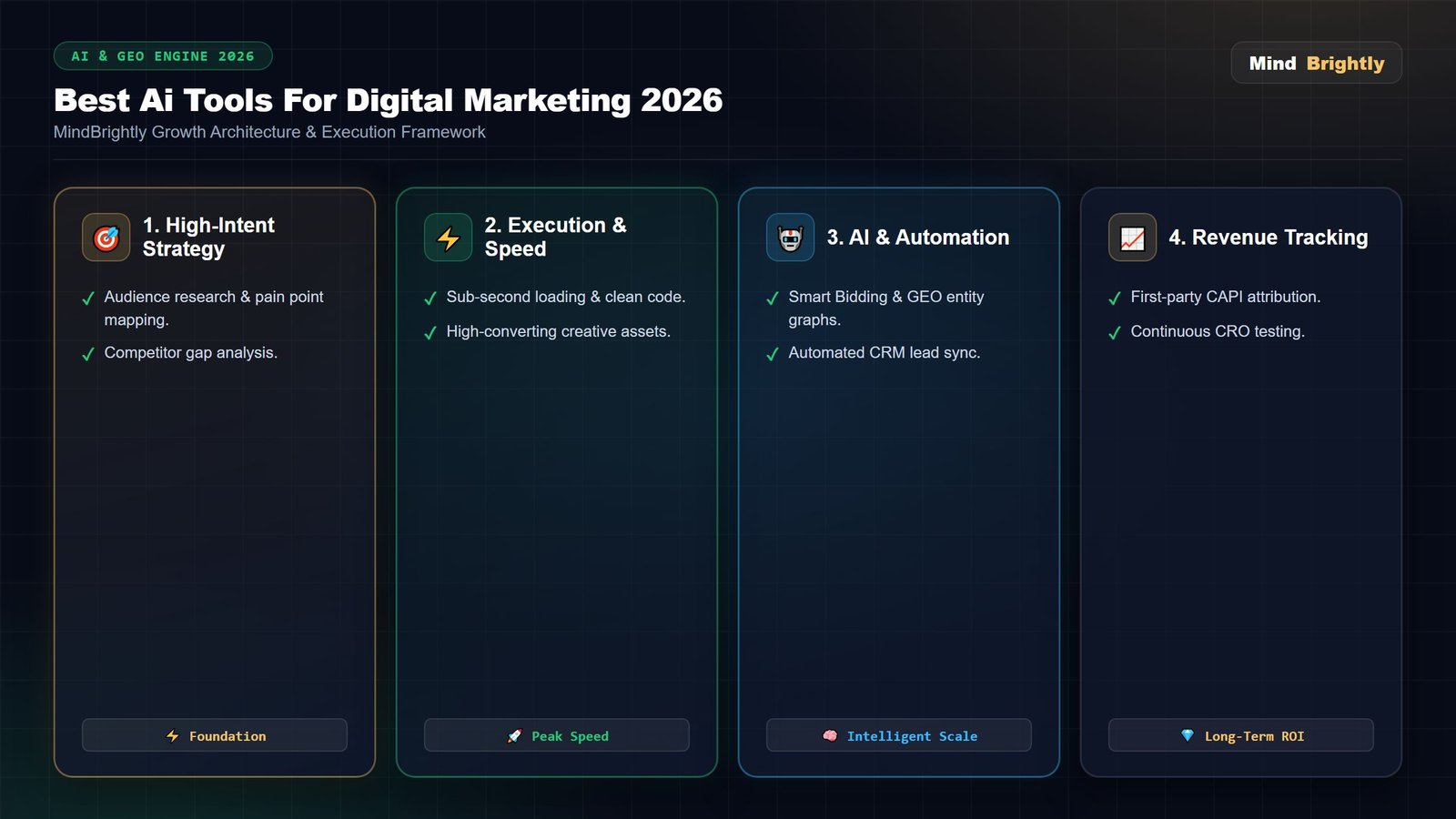
Quick Answer (Key Takeaway)
The best AI digital marketing stack in 2026 combines: Claude 3.5 Sonnet for natural brand copywriting and conversion messaging; ChatGPT (GPT-4o) for structured SEO clustering and ad hooks; Google Gemini 2.0 for cross-referencing search data and multimodal analytics; Perplexity Pro for real-time market research; Midjourney v6 for high-converting visual creatives; and Autonomous AI Agents for end-to-end campaign tracking and automated reporting.
If your marketing team or agency is still using AI solely to write generic 500-word blog posts, you are already operating two years behind the industry curve. In 2026, artificial intelligence has evolved far beyond raw text generation. AI tools now power real-time competitor research, programmatic creative iteration, predictive ROAS bidding on Google and Meta, and fully autonomous multi-step execution.
For businesses in India, the Tricity, and across India, this evolution represents an unprecedented equalizer. A 3-person in-house team or a lean local business equipped with the right AI stack can now produce creative volume and analytical precision that previously required a 50-person agency department.
However, with thousands of SaaS tools slapping "AI" onto their landing pages, separating genuine productivity powerhouses from overpriced wrappers is difficult. In this definitive 2026 guide, we break down the exact AI marketing stack we deploy at MindBrightly across SEO, paid advertising, media production, and analytics.
1. The Foundation: Large Language Models (LLMs) Compared
At the center of any AI marketing workflow is your primary intelligence engine. In 2026, three frontier models dominate marketing applications, each with distinct strengths:
When to Pick Which Model
- Choose Claude 3.5 Sonnet when writing landing page headlines, email sequences, or detailed articles where sounding like a knowledgeable human consultant is paramount. It avoids tired buzzwords like "delve", "tapestry", and "revolutionize" far better than other models.
- Choose ChatGPT Plus (GPT-4o) for brainstorming 50 Meta ad angle variations in two minutes, parsing CSV export sheets of Google Search Console keywords, and writing Python scraping scripts.
- Choose Google Gemini when you need to upload a 200-page competitor PDF audit, brand guidelines document, or whole website architecture file. Gemini processes massive context without hallucination.
2. AI Search & Market Intelligence Tools
Traditional keyword research tools like Ahrefs and SEMrush remain essential for tracking keyword volumes, but they don't capture the conversational search queries taking over AI answer engines. These tools give you the competitive edge:
- Perplexity Pro: Acts as an AI-powered conversational search engine with live web grounding. Use it to analyze competitor pricing across India and India, summarize Reddit sentiment around consumer pain points, and uncover emerging queries before keyword tools register search volume.
- ChatGPT Search: Provides direct live citations from the web. Testing your business queries in ChatGPT Search is now a mandatory step in our AI SEO services to identify whether your brand is being cited in answer boxes.
- Google AI Studio: Gives developers and marketers direct access to Gemini models with temperature controls and structured JSON output prompts, ideal for bulk meta tag generation and schema building.
3. Visual & Creative Asset Generation
High-converting ads require rapid creative testing. Rather than waiting weeks for a graphic designer to produce two ad concepts, modern marketers use AI image generators to create dozens of visually distinct concepts per day:
- Midjourney v6: The gold standard for photorealistic product staging, luxury lifestyle mockups, and eye-catching editorial headers. It accurately handles lighting, depth of field, and brand color palettes.
- Canva Magic Studio: Excellent for fast social media layout assembly, one-click background removal, text-to-graphic generation, and multi-format resizing for Instagram, LinkedIn, and Facebook Ads.
- Figma AI: Accelerates UI/UX wireframing and landing page mockups for conversion rate optimization. Learn more about how design impacts conversions in our CRO services breakdown.
4. AI Video Production & Short-Form Automation
Video is the highest-engagement format across Instagram Reels, YouTube Shorts, and Meta Ads. Creating consistent video used to require expensive cameras, studios, and days of post-production. Today's AI video tools streamline the pipeline:
- HeyGen & ElevenLabs: Allows brands to generate studio-quality talking-head avatar videos and hyper-realistic voiceovers in English, Hindi, and regional Indian languages from a single written script.
- CapCut Desktop AI & Opus Clip: Automatically analyzes long-form podcasts, webinars, or YouTube videos, detects the most engaging 30-second moments, adds animated dynamic captions, and formats them for viral short-form distribution.
- Runway Gen-3 & Sora: Generate cinematic B-roll and visual transitions from simple text prompts, giving video ads high production value on modest budgets. Explore our agency media production services for full-scale video solutions.
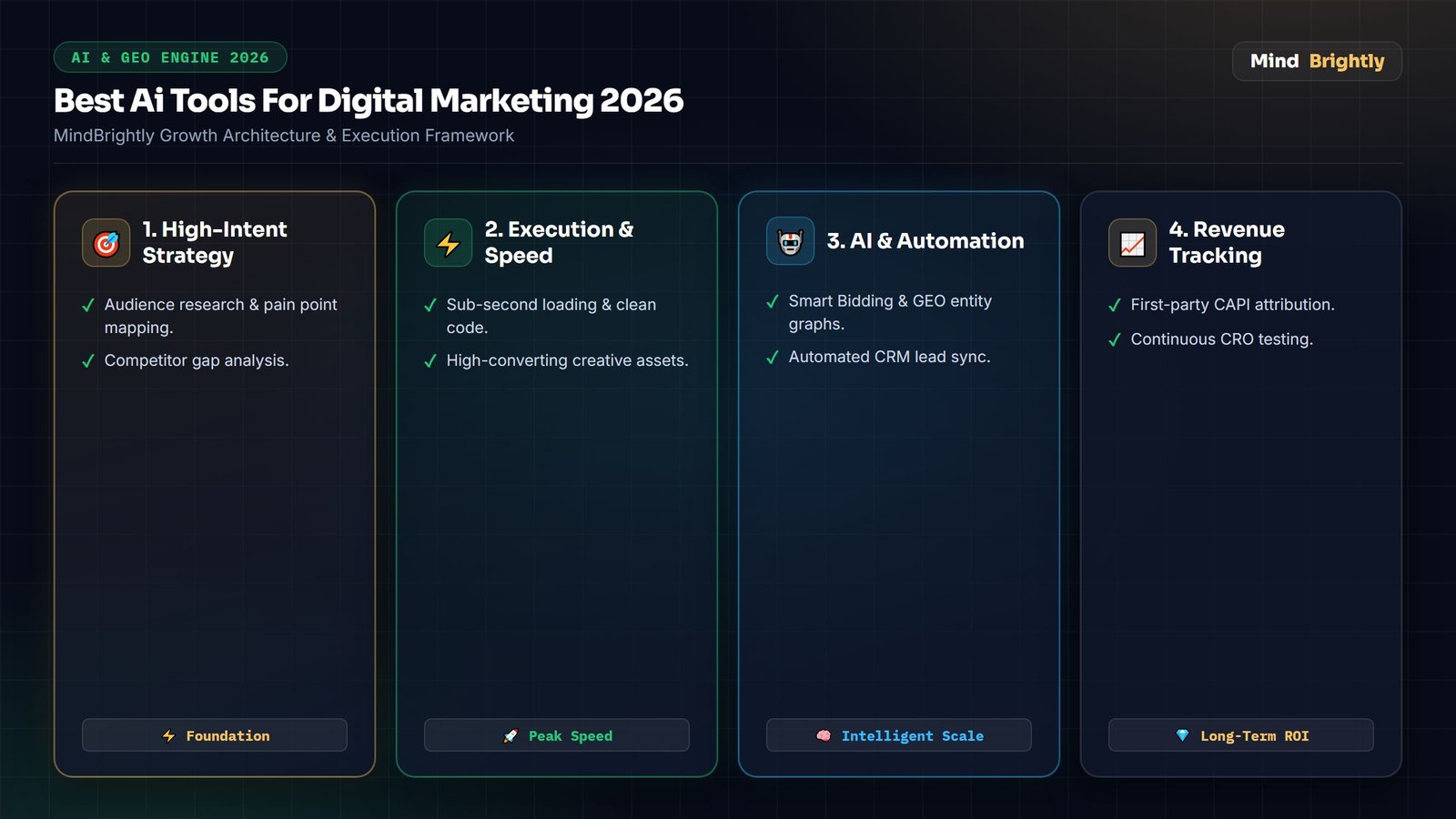
5. Autonomous AI Marketing Agents (The 2026 Frontier)
The biggest leap in 2026 is the transition from **chatbots** to **autonomous AI agents**. While a chatbot answers questions when prompted, an AI agent takes a high-level goal and autonomously executes a multi-step workflow.
For example, an AI agent connected to your Google Ads API can:
- Monitor search query reports every morning at 6:00 AM.
- Identify non-converting search terms with zero ROAS and add them as negative keywords.
- Generate 3 new responsive search ad headlines based on top-performing organic keywords.
- Send a clean, plain-language summary of ad spend and conversions to your WhatsApp or Slack.
Tools like Google Antigravity (AGY), LangChain, and n8n AI Workflows allow marketers to build these custom automations without writing complex backend infrastructure from scratch.
The 5-Step AI Implementation Blueprint for Small Businesses
To avoid shiny object syndrome and actually generate revenue with AI tools, follow this structured 5-step roadmap:
- Step 1: Audit Your Bottlenecks. Don't try to automate everything. Identify the single task that consumes the most time — whether it is writing ad copy, answering repetitive customer DMs, or building monthly reports.
- Step 2: Establish a Central Brand Knowledge Vault. AI outputs are only as good as the context you feed them. Create a markdown or Notion document containing your business elevator pitch, customer personas, pricing, FAQs, and tone guidelines. Paste this into your LLM prompts.
- Step 3: Keep a Human in the Loop. Never publish unedited raw AI outputs directly to your site or ads. Treat AI as a brilliant junior assistant that does 80% of the heavy lifting, while an experienced human marketer reviews and injects local authenticity.
- Step 4: Align with Google's Helpful Content Guidelines. Google does not penalize AI content; it penalizes unhelpful, thin, regurgitated content. Ensure your articles provide real information gain, proprietary data, or unique local market case studies. Review our guide on what is E-E-A-T and why it matters.
- Step 5: Measure Real ROI. Track metrics that matter: cost per lead, organic search rankings, and ROAS. If a tool doesn't save at least 5 hours a week or increase conversion efficiency, cut it from your subscription stack.
How MindBrightly Integrates AI for Client Growth
At MindBrightly, we don't treat AI as a replacement for marketing expertise — we use it as a high-powered engine to deliver faster results, deeper data insights, and higher return on ad spend for businesses in India and across India.
Whether you need full-funnel SEO services to rank in both traditional Google search and AI Overviews, high-converting Google Ads management, or want to master these tools through our mentor-led digital marketing courses, our India-based team is here to help you lead your industry.
You can also partner with us through our Free Affiliate Program to earn a 10% commission on every business or student you refer, backed by high-converting AI marketing funnels.
FAQ
Frequently Asked Questions
What are the best AI tools for digital marketing in 2026?
Which AI model is best for SEO and content writing?
Can small businesses replace marketing agencies with AI tools?
How does Google evaluate AI-generated marketing content?
What is an autonomous AI agent in digital marketing?
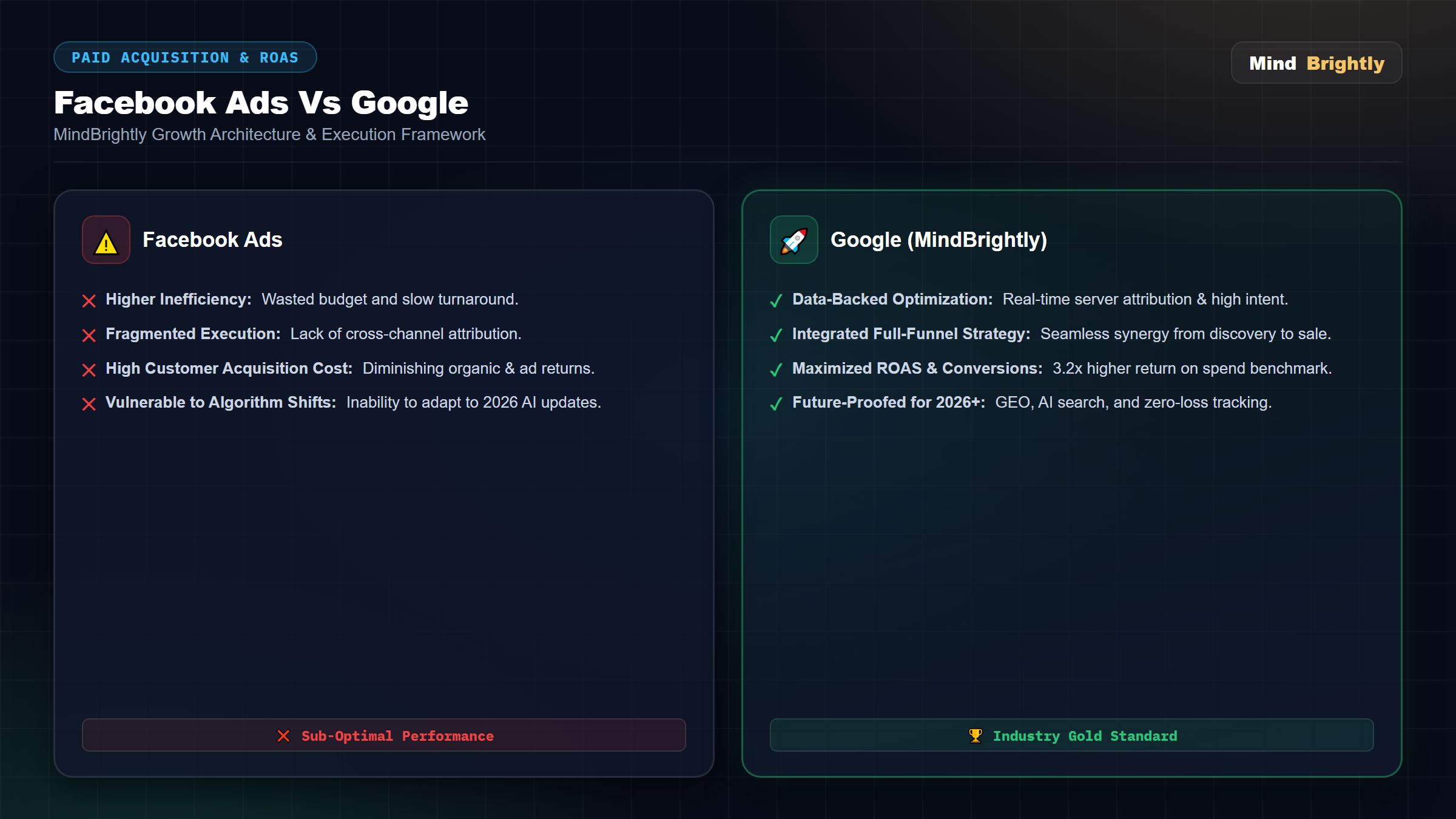
The Ultimate 2026 Framework for Dominating Digital Marketing
While the fundamentals of best ai tools for digital marketing 2026 remain crucial, the landscape has shifted violently due to Generative AI, privacy protocols (iOS 14.5+), and changing consumer psychology. In this exclusive deep-dive, we break down the exact technical frameworks MindBrightly uses to generate 10x ROI for our enterprise and local clients.
1. The Shift to Generative Engine Optimization (GEO)
Traditional Search Engine Optimization (SEO) was built on "Ten Blue Links." In 2026, over 65% of informational queries end in a "Zero-Click Search." Users ask a question, and Google AI Overviews, ChatGPT Search, or Perplexity AI instantly provide the answer without the user ever clicking your website.
To adapt your Digital Marketing strategy, you must transition to Generative Engine Optimization (GEO). AI models do not read websites like humans; they parse knowledge graphs and assess entity relationships.
- Entity Salience: Your brand must be recognized as a distinct entity in Google's Knowledge Graph, not just a keyword string.
- Information Gain: AI models penalize derivative content. Your articles must include proprietary data, original research, or unique expert quotes that exist nowhere else on the internet.
- Citation Formatting: Structuring your data in clean, semantic HTML tables and bullet points increases the likelihood of an AI tool citing you as the primary source in a summarized answer.
2. Defeating Signal Loss with Meta Conversions API (CAPI)
If your Digital Marketing campaigns rely solely on browser-based tracking (like the standard Meta Pixel or Google Analytics 4 client-side tags), you are bleeding budget. Browsers like Safari (ITP) and Firefox aggressively block third-party cookies, and iOS 14.5+ users overwhelmingly opt out of tracking.
The Solution: Server-Side Tracking. By implementing Google Tag Manager Server-Side (sGTM), the data flow changes entirely. Instead of the user's browser sending a signal to Facebook (which gets blocked), your web server directly sends a secure, hashed API payload to Meta's servers.
This recovers up to 40% of "lost" conversion data. When Meta's Advantage+ algorithms receive 40% more conversion signals, they exit the learning phase faster, drastically reducing your Cost Per Acquisition (CPA).
3. The B2B Playbook: Account-Based Marketing (ABM)
Applying B2C tactics to a B2B Digital Marketing strategy is the number one reason agencies fail. B2B sales cycles take 3 to 12 months, involve multiple stakeholders (CFO, CTO, Procurement), and have high ticket values. You cannot sell a $50,000 SaaS contract using a generic Facebook image ad.
MindBrightly utilizes Account-Based Marketing (ABM). We do not target "demographics"; we target specific companies.
- IP Identification: We identify the corporate IP addresses of your top 100 target accounts (e.g., Infosys HQ in Bangalore).
- Role-Based Targeting: We run LinkedIn Thought Leadership Ads exclusively to employees holding "Director" or "C-Level" titles within those specific IPs.
- High-Intent Lead Magnets: The ad creative is never "Buy our software." It is an interactive ROI Calculator or an in-depth Industry Whitepaper that requires a work email to access.
4. WhatsApp Automation & Zero-Friction Lead Nurturing
In the Indian market, email marketing is practically dead for B2C and struggling in B2B. With average open rates plummeting below 15%, relying on email autoresponders for your Digital Marketing campaigns will result in massive lead drop-off.
Enter the WhatsApp Cloud API. With a 98% open rate, WhatsApp is the ultimate conversion engine. When a prospect submits a lead form on your website or Meta Ad, our automated systems instantly (within 3 seconds) send them a personalized WhatsApp message.
- Instant Gratification: The message contains exactly what they requested (a PDF brochure, a pricing link, or a portfolio).
- Interactive Buttons: We use WhatsApp interactive UI (Quick Reply Buttons) to ask qualifying questions like "What is your budget?" or "Schedule a Call."
- AI Chatbot Handoff: If the user asks a complex question, our integrated AI chatbot answers them instantly based on your company's knowledge base, only handing over to a human agent when the prospect is ready to close.
5. Conversion Rate Optimization (CRO) & Core Web Vitals
Driving 10,000 visitors to a slow, unoptimized landing page is a waste of capital. Your Digital Marketing strategy is only as strong as your Conversion Rate.
Google's Core Web Vitals (CWV) algorithm update mandates that sites pass stringent speed tests. Specifically, your Largest Contentful Paint (LCP) must occur under 2.5 seconds, and your Interaction to Next Paint (INP) must be under 200 milliseconds.
To achieve this, we abandon bloated WordPress templates. We engineer custom architectures using tools like Vite and static-site generation. A site that loads in 0.8 seconds not only ranks higher organically but enjoys a significantly lower Cost Per Click (CPC) on Google Ads due to higher Quality Scores.
Take Your Digital Marketing to the Enterprise Level
Stop losing market share to competitors with inferior products but superior data pipelines.
Explore MindBrightly's Core Services & Industry Solutions
Core Growth Services
Industry Specific Marketing
Flawless Execution
Our Best AI Tools for Digital Marketing Blueprint
We don't do guesswork. Every campaign follows a rigorous, data-driven framework designed to maximize ROI and eliminate wasted spend.
Deep Audit & Strategy
We analyze your current setup, spy on your top competitors, and identify exact conversion bottlenecks before spending a single rupee.
Technical Implementation
From Server-Side Tracking to robust Schema markup, we lay a flawless technical foundation so algorithms feed on perfect data.
Aggressive Scaling
Once we hit your target Cost Per Acquisition (CPA), we aggressively scale the budget using AI-bidding to dominate your market share.
FAQs About Best AI Tools for Digital Marketing
Common questions we get from founders and marketing heads.
How long does it take to see ROI from Best AI Tools for Digital Marketing? +
Do you require long-term lock-in contracts? +
How do you handle reporting and transparency? +
Ready to Dominate Your Local Market?
Stop guessing and start scaling. Let our Chandigarh-based team build a data-driven strategy that turns clicks into paying customers.